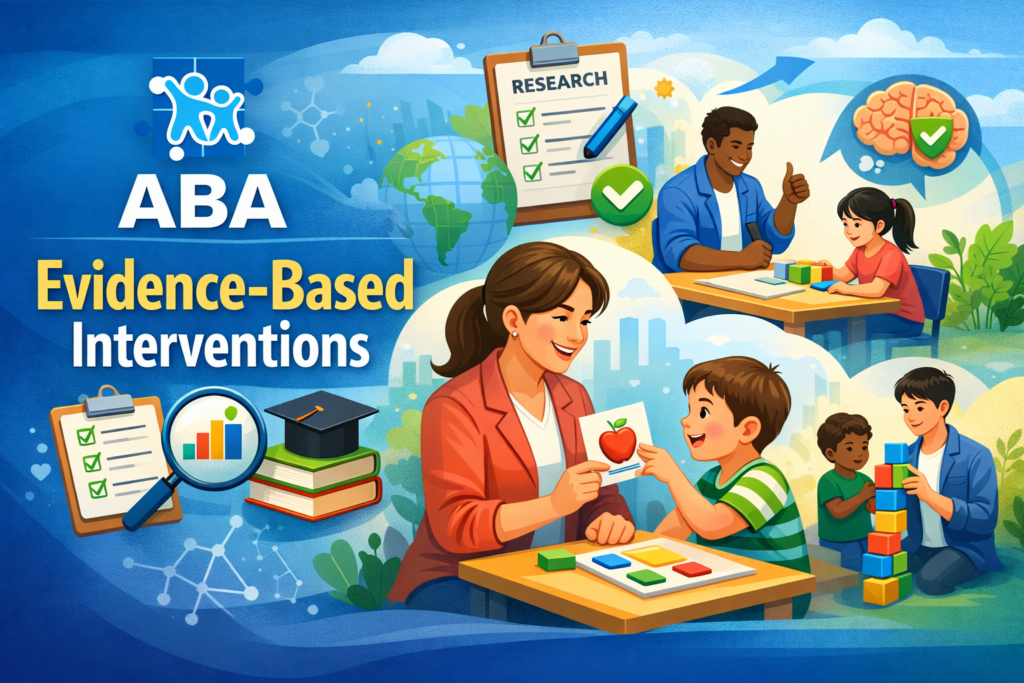
When working with children diagnosed with Autism Spectrum Disorder (ASD), it is essential to use evidence-based practices (EBPs)—interventions that have been researched and proven effective. These practices are backed by data, ensuring that children receive the most effective support possible.
Examples of Commonly Used Evidence-Based Practices in ABA
Reinforcement – Providing something meaningful or motivating after a behavior occurs, making it more likely that the behavior will happen again in the future. At ABD, reinforcement is individualized, what works for one learner may not work for another. By identifying what motivates each individual learner, therapists can build new skills, improve communication, and support meaningful, lasting behavior change.
Discrete Trial Training (DTT) – Breaking skills into small, manageable steps and teaching them systematically with clear instructions and reinforcement. DTT is especially effective for teaching foundational skills such as communication, imitation, matching, and early academics. As the child masters skills, they are gradually practiced in more natural environments to promote independence and generalization.
Natural Environment Teaching (NET) – Embedding learning opportunities into everyday activities and is especially effective for teaching communication, social, and daily living skills to promote skill generalization. NET takes advantage of naturally occurring opportunities such as playtime, daily routines, and real-life interactions to teach meaningful skills.
Chaining– Teaching complex skills by breaking them into smaller steps and reinforcing each step in sequence (e.g., handwashing, tying shoes).
Functional Communication Training (FCT) – Teaching alternative ways to communicate (e.g., using words, signs, or communication devices) to reduce challenging behaviors.
Prompting & Fading – Providing assistance to help a learner respond correctly. Prompts can take many forms, including verbal cues, gestures, modeling, or physical guidance. The goal is to ensure success during learning and reduce frustration. While fading is the gradual removal of those prompts as the learner becomes more confident and capable. Instead of relying on help, the individual begins to perform the skill independently.
Functional Behavior Assessments (FBA) used to understand WHY behaviors occur. An FBA helps determine whether the behavior is maintained by factors such as attention, escape, access to items, or sensory input. This ensures that we are using the most effective strategies and addressing the function of behavior!
Mand Training Teaches individuals how to communicate their wants and needs effectively with others. By strengthening communication skills through mand training, individuals can better express their needs, reduce frustration, and increase independence across home, school, and community settings.
Not all interventions are created equal, and it’s crucial to rely on scientifically proven strategies when supporting children with ASD. By using these evidence-based practices both in therapy and at home, we can help children develop essential skills and thrive in their daily lives.
At Advanced Behavioral Dimensions, LLC, we are committed to providing high-quality, evidence-based ABA therapy to help children reach their full potential. We train our Registered Behavior Technicians (RBTs), parents, caregivers, and teachers on the proper use of these interventions.
Want to learn more about how ABA can support your child? Contact us today!
